Earthquakes in Albania — Risks for Tourists
Earthquakes in Albania occur frequently, but are not very destructive. They do not pose a danger to tourists.
Let’s consider the situation in more detail.
Essential Travel Resources
Before you head out, sort your travel essentials to secure the best rates:
- Car Rental: Compare local deals and prices on DiscoverCars.
- Excursions & Guides: Book top excursions and local guides on GetYourGuide.
- Mobile Internet: Instant internet connection upon arrival via Yesim eSIM.
- Where to Stay: Find top-rated hotels and apartments on Expedia.
- Travel Insurance: Protect your trips with SafetyWing.
Geographical location of Albania and seismic activity
The Republic of Albania is located on the Mediterranean fault line. Here, two tectonic plates meet at once: the African and Eurasian, as well as the Adriatic-Balkan microplate.
On the territory of Albania there are two active fault lines between the plates. The Shkodra fault and the Ionian fault are the main sources of earthquakes.
The plate is a petrified surface of the earth with a thickness of 10 to 80 km. It is located outside the planet and is covered with soil, forests, rivers and lakes.
Planet Earth is a young planet. Today complex thermal processes are taking place in its depths. As a result, huge plates move and collide with each other.
Plates behave differently when colliding. Sometimes they push against each other and create internal stress. Sometimes one plate creeps onto another.
As a result of plate collisions, various natural disasters occur. These include earthquakes, tsunamis, huge ground cracks, and crustal failures.
The essence: collisions of plates lead to tremors of the earth’s crust. Collisions are provoked by external factors. An example is temperature changes in the air and seas.
Internal processes are often accompanied by magma release. It splashes from inside the planet through volcanic craters to the outside.
Albania is located directly at the junction of two tectonic plates. This leads to regular seismic activity of 3 or 4 points in winter.

Earthquakes in Albania: Cyclic Patterns
Studies conducted in Albania in 1970 revealed the frequency of earthquakes of different magnitudes:
- Magnitude 5.0 occurs once every 3.6 years;
- Magnitude 6.0 occurs once every 29.1 years;
- Magnitude 7.0 occurs once every 505.6 years.
💡 Interesting fact: Earthquakes with a magnitude above 6.0 on the Richter scale are considered dangerous.
We can evaluate earthquakes based on maximum recorded intensity. Different areas have experienced varying magnitudes:
- Northern coast (Shkoder, Lezhe region): 7.0–7.5 magnitude earthquakes are more frequent.
- Southern coast (Sarande, Gjirokaster region): Maximum magnitudes range between 6.0–7.0.
- Tirana region: Expected maximum earthquake magnitude is 5.5–6.0.
Depth of Earthquakes:
- Durres — 10 and 20 km;
- Kukes, Peshkopi — 54 km;
- Gjirokaster — 48 km;
- Berat, Ura Vajgurore, Gramsh, Cerrik — 48 km;
- Tirana, Ulcinj-Bar — 46 and 53 km;
- Belsh — 10 km.
The depth of tremors indirectly indicates the thickness of the tectonic plate in that region.
Studies have shown that earthquakes occur in a predictable cycle.
This made it possible to develop safety measures for construction. They apply to buildings and infrastructure, including roads in Albania.
Albania: Seismic Safety and Risk Assessment
Ancient earthquakes in Albania could not be measured. There were no instruments or universal methods to assess them. The Richter scale was introduced only in 1935.
It is unknown how strong ancient earthquakes were on the Richter scale. Estimations based on historical accounts are unreliable. Thus, the exact long-term dynamics of earthquakes remain unclear.
Earth is millions of years old. Yet accurate earthquake statistics have only been collected for the past 100 years.
This period is too short. The available data is insufficient to fully predict future seismic disasters.
💡 Interesting fact: According to Albanian construction standards, buildings must withstand ground movements up to 8.0 magnitude.
Modern buildings in Albania are constructed with potential seismic activity in mind.
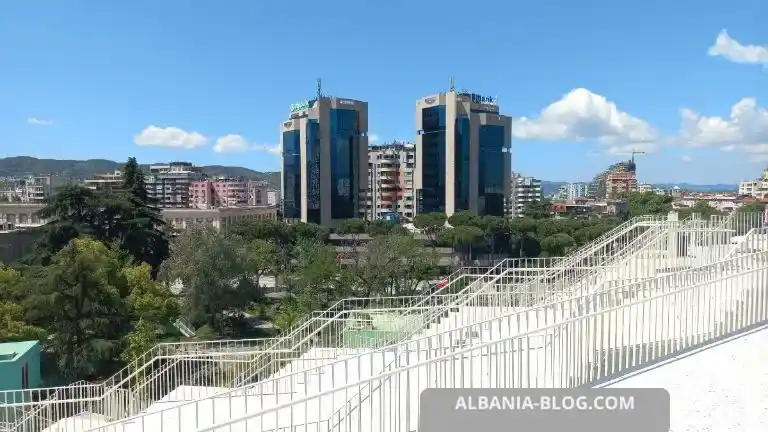
Today, central Tirana features many high-rise buildings. They are designed according to strict safety regulations to minimize risks.

Albania: Tourist Safety During Earthquakes
The seismic zone around the Pacific Ocean is far more dangerous than the Mediterranean region.
The Mediterranean seismic zone is less life-threatening. However, there are two particularly active regions: Sicily (Italy) and the fault line near Turkey.
Albania and Montenegro are safer compared to southern Italy and Turkey.
According to statistics, 90% of all earthquakes occur in the Pacific Ring of Fire. Only 5% occur in the Mediterranean zone.
Let’s analyze Albania as part of the Mediterranean region.
Between 1959 and 2024, two major earthquakes have been recorded in Albania:
- November 30, 1967 — Magnitude 6.5;
- November 26, 2019 (Durres) — Magnitude 6.4.
Thus, in the last 65 years, Albania has not experienced earthquakes stronger than magnitude 6.5.
Look closely at the dates of events in the Mediterranean zone. You will notice seismic activity in winter, starting in November.
Most of the strongest earthquakes in this region occur between November and April.
The analysis shows that seismic activity in Albania is highly seasonal, with the highest activity observed in the winter months. In summer, seismic activity drops sharply to almost zero.
Summary: Summer has the lowest risk of earthquakes, making Albania a safe destination for foreign tourists.
Frequently Asked Questions (FAQ)
Are earthquakes in Albania dangerous for tourists in summer?
No, during summer seismic activity in Albania drops to a minimum level. Historically, noticeable tremors occur predominantly during the winter and spring periods.
Are hotels and modern buildings in Albania safe during an earthquake?
Yes, modern buildings in Albania are constructed according to strict seismic safety standards designed to withstand ground tremors of up to 8.0 magnitude.
Which regions in Albania experience the highest seismic activity?
The most active areas are the coastal zones and fault lines near Durres, Vlore, Lezhe, and Gjirokaster, though major earthquakes are extremely rare.
What should a tourist do during a noticeable earthquake?
Stay calm. Indoors, move away from windows and heavy furniture, and take shelter near a load-bearing wall or under a sturdy table. Outdoors, stay clear of buildings, trees, and power lines.
Conclusions
- Tourists visiting the country in summer have a minimal risk of encountering earthquakes in Albania.
- Seismic activity slightly increases in winter, but the risk of major earthquakes remains minimal.
Thus, during the summer season, Albania is a very safe place for travel and tourism. According to statistics, earthquakes occur more frequently in winter and do not pose a danger to tourists.
If you want to better understand the country as a whole, check out the article Albania — Key Facts and information about the country. It contains key information about the language, currency, holidays, climate, and other peculiarities.
Author content.
If this article helped you, you can support the author with a coffee.