Composition of Yugoslavia
The composition of Yugoslavia varied over the years, but Albania (properly the Republic of Albania) was never part of Yugoslavia.
This is the correct answer to the question “Was Albania part of Yugoslavia?”
Essential Travel Resources
Before you head out, sort your travel essentials to secure the best rates:
- Car Rental: Compare local deals and prices on DiscoverCars.
- Excursions & Guides: Book top excursions and local guides on GetYourGuide.
- Mobile Internet: Instant internet connection upon arrival via Yesim eSIM.
- Where to Stay: Find top-rated hotels and apartments on Expedia.
- Travel Insurance: Protect your trips with SafetyWing.
Yugoslavia: Composition During Different Periods of History
Three periods can be identified when the name Yugoslavia appeared on the map of the Balkan Peninsula.
In each period, the term “Yugoslavia” referred to a different country in terms of its composition, economy, and politics.
The only uniting factor was that, each time, the center was Serbia, with its capital in Belgrade.
First Period: 1918-1945
Austria-Hungary was defeated in World War I, and part of its former territories united to form a new state. Essentially, the former territories of Austria-Hungary joined Serbia.
On December 1, 1918, three countries — Serbia, Slovenia, and Croatia — formed a kingdom (monarchy), which later included the territories of modern-day Montenegro, Kosovo, North Macedonia, Bosnia, and Herzegovina. The state was named the “Kingdom of Serbs, Croats, and Slovenes.”
The unification was led by the Serbian Karađorđević family. From 1921 to 1934, King Alexander ruled, and from 1934 to 1945, his son, King Peter II, ruled.
In 1929, the state was renamed the “Kingdom of Yugoslavia.” The goal was to unite the South Slavs and combat local nationalism within each territory. The capital was in Belgrade, and the Serbian idea of a unitary state dominated.
This period lasted until November 29, 1945, when the monarchy was abolished by the communists.
Albania was not part of the “Kingdom of Yugoslavia.”

Second Period: 1945-1992
Simultaneously with the abolition of the monarchy, the “Federal People’s Republic of Yugoslavia” (FNRJ) was formed.
In 1963, it was renamed the “Socialist Federal Republic of Yugoslavia” (SFRY).
The country was led by communists, with Josip Broz “Tito” at the helm.
An interesting fact: Tito’s nickname came from the words “you” and “do it”. In the local dialect, this sounded like “ti-to.” The leader often gave instructions and pointed out what needed to be done.
The SFRY included 6 nominally equal republics on a federal basis. These are: Serbia, Slovenia, Bosnia and Herzegovina, Croatia, Montenegro, Macedonia.
This period lasted from 1945 to 1992.
From 1945 to 1948, Albania maintained active communication with Yugoslavia. However, the final choice was made to align with the USSR under Stalin’s leadership.
Albania was never part of either FNRJ or SFRY.
In the photograph, in the center, is the Chairman of the Council of Ministers of Albania, “Comrade Enver Hoxha.”

Third Period: 1992-2006
Dissolution of SFRY:
Slovenia and Croatia declared their independence on June 25, 1991, leaving the federation.
Macedonia followed suit and declared its independence on December 19, 1991.
Then, in February 1992, Bosnia and Herzegovina declared its independence.
Only two countries remained in the federation: Serbia and Montenegro. They declared the creation of the “Federal Republic of Yugoslavia” (1992-2003). The union was later renamed the State Union of Serbia and Montenegro (2003-2006).
In 1998, the Kosovo conflict began, and Serbian forces took control of Kosovo. NATO assisted the rebels in Belgrade, and Serbian troops withdrew from Kosovo in June 1999.
In 2003, the country’s name changed to “Serbia and Montenegro” (2003-2006).
The Republic of Montenegro declared its independence in June 2006.
In February 2008, the Republic of Kosovo declared its independence.
Albania was not part of either the FRY or “Serbia and Montenegro.”
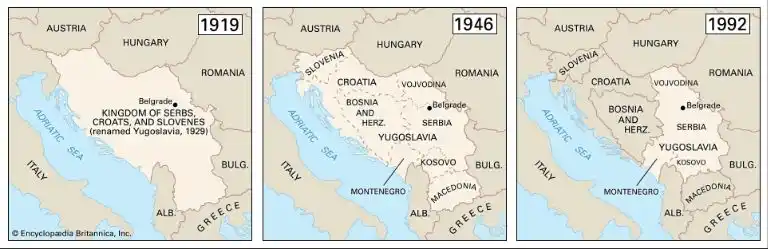
The three different maps clearly show the composition of Yugoslavia during various periods in history: 1919, 1946, and 1992.
You can learn more about the history of Yugoslavia in the Encyclopedia Britannica Ink.
Maps of the Balkan Peninsula in 1919, 1946, and 1992.
Conclusions
The term “Yugoslavia” appeared in an attempt to create a larger state in 1929, with Serbia at its center.
In 2006 after Montenegro left the FRY the term disappeared from history.
The composition of Yugoslavia changed, but Albania was never part of it during any period of history.
👉 If you want to better understand the country as a whole, check out the article Albania — Key Facts and Information about the Country. It contains key information about the language, currency, holidays, climate, and other peculiarities.
Author content.
If this article helped you, you can support the author with a coffee.