Myths About Albania — Arguments and Facts
Myths about Albania appeared due to the rapid development of the country and the lack of fresh information about the latest changes.
Essential Travel Resources
Before you head out, sort your travel essentials to secure the best rates:
- Car Rental: Compare local deals and prices on DiscoverCars.
- Excursions & Guides: Book top excursions and local guides on GetYourGuide.
- Mobile Internet: Instant internet connection upon arrival via Yesim eSIM.
- Where to Stay: Find top-rated hotels and apartments on Expedia.
- Travel Insurance: Protect your trips with SafetyWing.
Four Myths About Albania
I sometimes hear from people that here:
- there is only mafia around;
- stolen Mercedes cars are everywhere;
- it is a Muslim country;
- the roads are bad.
All these are misconceptions of those who do not know the real situation in 2025.
Let me remind you that over the past 100 years, the country has gone through 1,000 years of development. And over the past 30 years, it has gone through 300 years of development compared to Europe.
Numerous conquerors hindered the country’s development, even prohibiting the official use of the Albanian language, which led to the emergence of more than 10 different language variants in various regions of the country.
Since 1972, a unified Albanian language has been used in the country: “gjuha shqipё letrare” or “literary Albanian language.”
Today, Albania is a secular democratic state. Only since 1991 has the country been open to the outside world.
The high speed of changes leads to rapid obsolescence of information.
Changes occur too quickly, and many do not manage to keep track of them. Thus, people remain trapped in the past, thinking with outdated information.
Let’s look at the myths about Albania and address each point of the stereotypes.

First Myth: Mafia and Corruption in Albania
Today, the government has created and persistently develops several anti-corruption projects operating on a “one-stop-shop” principle.
For example:
- The e-Albania portal, where you can order documents, check fines, and write a letter to any official body of Albania.
- The Platforma e Bashkeqeverisjes (For Albania, which we love) portal, through which you can report any type of corruption, abuses by local authorities in any sphere of social life, submit specific improvement proposals, request communication with a minister, share your story, and more.
- The ADISA Integrated State Services Center, which provides 343 services and already covers 12 settlements, highly appreciated by many residents. It represents 8 state institutions: ZRPP, ISSH, FSDKSH, DPT, QKB, SHKP, DRTB, ALUIZNI.
The work is progressing at a large scale, and the current government is eliminating the shortcomings of past eras. Figuratively speaking, the economic ship is sailing with the wind towards openness and transparency.
By 2030, Albania plans to join the European Union, as planned in the documents.
It is important to know that the task of a democratic state is to ensure people have freedom of choice and an equal approach while suppressing emerging crimes.
Thus, there is no foundation for corruption.
The transparency of officials’ activities, the ability of individuals to submit statements online, order documents, and constructively resolve issues: a significant step forward in the field of freedom and democracy.
Tourists are not affected by the “local kitchen” (daily life and issues), and this article only shows the real state of affairs — the rapid advancement of the country towards democracy and openness.
Below is a photo of the ADISA state services office in Fier.

Second Myth: Only Stolen Mercedes Cars in Albania
The myth remains from the 90s when life was turbulent, and crime, like foam in a stormy sea, surfaced.
If you look closely, you will see many foreign cars on the streets of Albanian cities: Mercedes, Audi, Volkswagen, exclusive cars, and even vintage cars.
When I first arrived in Tirana, I remembered seeing a large Mercedes dealership Auto Star Albania Sh.a. at the entrance. The showroom was so huge and spacious that it seemed incredible for a small country. At that moment, I realized it was an official dealership selling modern Mercedes cars.
It turned out that Kastrati Group opened the Mercedes Benz Shqipёri showroom on June 8, 2017, investing 30 million euros in this project.
Showroom coordinates: 41.365214, 19.710215
There are also showrooms of other automotive giants such as AUDI, BMW, TOYOTA, Volkswagen, and others.
Conclusion: if there are buyers and showrooms have been thriving for many years, it means someone is buying the cars.
Thus, the sight of a huge modern showroom near Tirana dispelled all my doubts about “stolen Mercedes cars.”

Third Myth: Albania Is a Muslim Country
The myth is easily debunked.
Constitution of Albania
Read the original Constitution of the Republic of Albania and see that the state is secular. More details about religion in Albania are provided in another article: the link will be below.
Official Holidays in Albania
Among the official holidays are both Orthodox and Catholic Easter. There are also Muslim religious holidays, such as Kurban Bayram.
Additionally, New Year and Catholic Christmas are officially celebrated in Albania.

Orthodox Albanian Communities
In southern Albania, there are strong Christian traditions and many Orthodox Christian communities.
There are also Orthodox cemeteries there.
Road signs are often duplicated in Greek.

Religious Polyphony (Multivoicing)
In fact, the country has four main religions and several others.
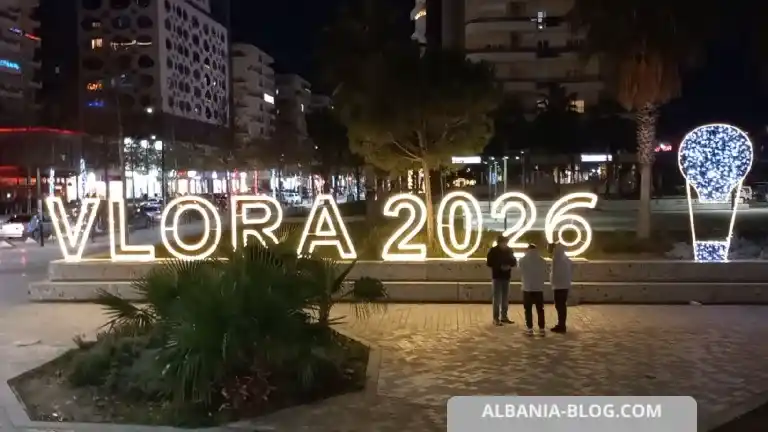
In Vlora, near Flag Square, there is the Muradi Mosque.
Just a couple of blocks away, there are Orthodox and Catholic churches.
You can see both churches and the mosque from the mountain in the city center, where the headquarters of the Bektashi Order is located.
Take a walk through the streets of Albanian cities. You will see churches, mosques, and religious buildings (e.g., tekke) of other faiths.

Enver Hoxha’s Regime: Atheism Policy
Communist and country leader Enver Hoxha, from 1945 to 1985, created the “new man” and fought against religious dominance in people’s minds.
Many religious figures were repressed during Enver Hoxha’s time. The property of religious organizations was nationalized.
Communists actively promoted atheism and godlessness.
Over 46 years of communist rule (from 1945 to 1991), Albania changed significantly, especially regarding religion and faith.

Vlora: Six Active Churches
- Muslim Mosque;
- Orthodox Church;
- Catholic Church;
- Tekke of the Bektashi Order, in Albanian “Teqeja e Kuzum Babait Vlorë,” founded in 1450, Kuzum Baba Sulltani;
- Baptist Church;
- Evangelical Christian Church.
In addition, on Sundays near the city theater, Jehovah’s Witnesses stand with their literature.
Thus, in April 2024, I discovered 7 (seven) religious movements in Vlora.
Modern Albania: Religious Tolerance
Modern Albanians are mostly people with a secular mindset.
Albanians care about family, work, and children. Religion is “in the background,” although many associate themselves with a particular faith. I would call it deep respect for other people and their opinions, including their faith.
Religious diversity indicates the supremacy of the Constitution in Albania. The modern approach is one of equality, respecting each citizen’s preferences in choosing their faith.
Thus, all facts indicate that the Republic of Albania is a secular state in matters of faith, not a Muslim state.

Fourth Myth: Bad Roads in Albania
Roads in 1991
Roads were called “directions” along which movement took place. They were very narrow and not designed for high-speed traffic.
Streets in cities were designed for rare movement of buses and special service vehicles. Ordinary citizens did not own cars in those days.
This problem existed in all countries after communist rule. A similar situation was in the USSR and all allied republics.
In those distant times, high-speed roads in Albania were deliberately not built. The reason was simple: to prevent a quick capture of the country by a “potential enemy.”
It is worth mentioning that behind every turn, a machine-gun bunker was hidden, guarding the road.
Interesting fact: according to unverified data, about 700,000 bunkers were built during the communist rule.
I personally sometimes accidentally discovered a bunker where I absolutely did not expect to see one. For example, along the coast in hard-to-reach places.
Instead of roads, the communists built bunkers.

Albania: Roads in 2024
Today, roads in Albania have taken on a completely different look.
Some projects have already been completed and delight drivers traveling on them.
Tunnels are being built, reducing travel time between cities and making routes easier for drivers.
The number of accidents, traffic jams, and stress is decreasing.
For example, on July 5, 2024, a 6-kilometer tunnel under the Llogara Pass near Vlora was put into operation. Passage through it is free.
High-speed highways with multi-lane traffic are being built: they will be both toll and free.
Albania: Development Prospects
Albania is progressing very quickly.
Albania’s trump card is its strategic location along the Ionian Sea coast. Tourists are the main focus.
- Year after year, statistics show an increase in foreign visitors to Albania. Over the past 10 years, the number of tourists visiting the country has grown from 1.7 million to 11 million in 2024.
- The national currency (lek) has been strengthening over the last 5 years. From 130 lek/euro in 2021 to 98 lek/euro in 2025. The economy is growing and strengthening.
Albania has chosen a strategically correct direction and has excellent prospects. Foreign investments in Albania’s economy are increasing every year.
Important to know: Money (investments) flows where there is trust, democracy, and stability.
Thus, myths about Albania are spread by those who lack fresh information about the country.

I hope we have debunked some prejudices about Albania.
👉 If you want to better understand the country as a whole, check out the article Albania — Key Facts and Information about the Country. It contains key information about the language, currency, holidays, climate, and other peculiarities.
Author content.
If this article helped you, you can support the author with a coffee.