Tirana, Albania (2026) — What to See, Where to Stay & Hidden Spots
Tirana is the capital of Albania and one of the most unique cities in the Balkans.
If you’re planning a trip and wondering what to see in Tirana in 1-2 days, this guide highlights the city’s top attractions, from Enver Hoxha’s bunkers to Mount Dajti.
Top attractions in Tirana
- Skanderbeg Square — a monument to the hero, the city center, and the Aeroexpress to the airport
- Bunkart 1 — Enver Hoxha’s bunker
- Bunkart 2 — a bunker for the secret services
- Tirana Pyramid — a symbol of a bygone era
- Stalin-era building, a pillbox, and a section of the Berlin Wall
Dajti Mountain — how to get there, a simple route - A large park and lake — a popular Albanian vacation spot
Many travelers choose accommodations in the city center for easy access to the main attractions.
Modern Tirana — The New Albania
Tirana is the capital and the face of the modern Republic of Albania (hereafter referred to as Albania).
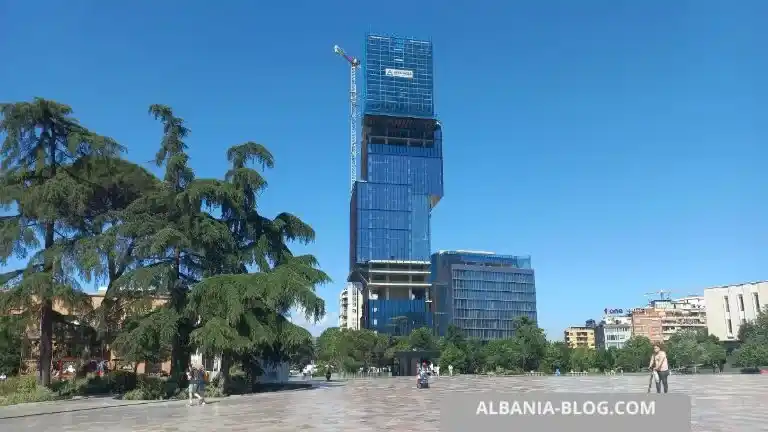
The city surprises visitors with its unusual architecture.
In recent decades, architects and designers of international level have worked actively on the city’s appearance.
- Among them are the Belgian studio 51N4E,
- the Italian firm Archea,
- the Dutch office MVRDV, and other leading global designers.
Today the city is surrounded by greenery and many parks with trees refresh the city.
In the center of the capital, on the square, there is a monument to Skanderbeg.
It is worth mentioning that a similar monument to Skanderbeg is erected in the city of Kruja.
History of Tirana
The city of Tirana was founded by the Ottoman general Barkinzade Süleyman Pasha in 1614.
He built a mosque, a bakery, and a Turkish bath (hammam). This is how the village became a small town with a population of 4,000.
- Thus, the year 1614 is considered the official founding year of the city.
- On January 31, 1920, at the Congress of Lushnja, Tirana was declared the temporary capital of the Albanian state.
- And from December 31, 1925, Tirana became the permanent capital of Albania with a population of about 17,000.
During Enver Hoxha’s rule, the population grew from 40,000 in 1945 to 250,000 by 1990.
Modern Tirana is a rapidly developing city where various world religions coexist peacefully.
It is also an exceptionally beautiful city with unique architecture, skyscrapers, parks, and the Dajti cable car.
Albania is actively preparing to join the European Union by 2030.
Tirana: Monument to Openness
In the center of Tirana, there is a symbolic monument representing Albania’s openness.
The cube splits open in two parts, and inside one part is the coat of arms of the Republic of Albania.
The monument stands in a pool with running water.
Symbolically, it represents distrust being broken and friendliness taking its place.
General Facts About the Albanian Capital
The capital is located in a fertile valley surrounded by several mountain ranges.
To the east lies Mount Dajti (Mali i Dajti), 1,612 meters high, and Mount Gropa (Mali me Gropa), 1,828 meters high.
- Tirana is 110 meters above sea level.
- 35 km to the west lies the Adriatic Sea and the city of Durrës.
- The Tirana River flows in the north of the city, and the Erzen River in the south.
- As of January 1, 2023, the population of Tirana County was 925,268.
There is Tirana County, within which there are four municipalities and the city of Tirana. The city, municipality, and county are separate entities with different areas and populations.
Due to unfamiliarity with Albania’s administrative divisions, some confuse the population numbers for “Tirana.” It is important to specify which entity is being referred to.
Bunkart 1 — Enver Hoxha’s Nuclear Bunker Museum
Bunker 1: History of Communist Albania
From 1945 to 1985, Albania was led by Comrade Enver Hoxha.
One part of his legacy is this bunker, which has been turned into a museum.
Bunker 1 (Bunkart 1) is a secure shelter that was intended for the safety of the head of state.
You can drive into it by car, and there is a traffic light installed for this purpose.
Entrance tunnel coordinates from the street: 41.349808, 19.860466
Tunnel to Bunker 1
The tunnel is 100 meters long and passes through a mountain.
Beyond the tunnel is a parking lot where tickets are sold. One ticket costs 700 lek (7 euros).
For updated ticket prices and hours, check the official BunkArt website: https://bunkart.al/
Bunkart 1 opening hours:
- Wed, Thu: 09:30 – 16:00
- Fri, Sat, Sun: 09:30 – 17:00
- Mon, Tue: closed.
Outside the bunker are guard barracks.
On the lawn, there is a park area with a working fountain.
Bunker 1: Interior Exhibition
Inside Bunkart 1 you will find:
- Several outer grated doors
- Two reinforced concrete doors with heavy bolts and three metal ones
- Three floors of long corridors and rooms
- Concrete walls one meter thick
The bunker was designed for the permanent residence of Albania’s top officials.
It includes living quarters, a canteen, an assembly hall, a gym, and a classroom for children.
Numerous documents and photographs recreate daily life under Comrade Enver Hoxha’s rule.
The museum holds cultural and educational significance not only for Albania but also for visitors from any country.
How to Get to Bunker 1 from Central Tirana
There is a bus stop in central Tirana that goes to Bunker 1.
It’s just across the street, 10 meters from the Rinas Airport express stop.
- The bus runs every 15 minutes.
- Ticket price: 40 lek.
- Route name on the bus: Portcelana.
Get off near the bunker.
Coordinates of the bus stop for Dajti Mountain and Bunkart 1: 41.328367, 19.820972
Bunkart 2 — Secret Police Museum in the City Center
Where Bunker 2 Is Located
The entrance to Bunkart 2 is on the southern side of Skanderbeg Square.
It is 100 meters from the Ethem Bey Mosque.
Next to the entrance is a Soviet “Gazik” jeep — the special service vehicle used by Enver Hoxha.
Coordinates for Bunkart 2: 41.327060, 19.819542
History of Bunker 2
Bunker 2 was built to assist Enver Hoxha’s security service.
It has only one main floor.
A ticket costs 700 lek (about 7 euros).
Inside is a long straight corridor with rooms displaying exhibitions.
You’ll see an interrogation room with flickering lights, a torture room, and detention cells.
There are many historical items and documents from that era.
The museum offers a comprehensive view of the operations of secret services in closed societies.
Under Enver Hoxha, Albania was a “closed” country. Entry and exit were nearly impossible.
Bunkart 2 opening hours:
- Sun–Thu: 09:30 – 18:00
- Fri–Sat: 09:30 – 20:00
- Open daily.
For the most up-to-date information, check the official BunkArt website: https://bunkart.al/
The Pyramid of Tirana — From Communist Monument to Modern Landmark
History of the Pyramid
The Pyramid was built in 1988 by Enver Hoxha’s daughter, Pranvera Hoxha, three years after his death.
There were many public debates in Albanian society about the future of the building.
In 2017, the government gave it a new life. Today, the Pyramid houses startups.
You can learn much more about the building from the designers — the Dutch firm MVRDV.
The Modern Pyramid Complex
Today, the complex is a favorite spot for tourists and serves as a viewing platform.
It is a very interesting place to visit, with a great view of the city from above.
The building is white, space-like, and unusually clean.
Standing on top, you feel like you’re on another planet. The white structure and blue sky create the illusion.
There are 116 steps to the top.
Inside, the Pyramid now hosts various events, exhibitions, and educational programs.
Pyramid of Tirana coordinates (Entrance): 41.322995, 19.821244
The Bunker and a Stalin-era building
After visiting the Pyramid, head west.
You’ll find yourself near a massive Stalin-era building. The Albanian leader “followed in the footsteps of Comrade Stalin.” He even copied the architecture that was dominant in the USSR at the time.
Next to this building there is a memorial: the Bunker, a piece of the Berlin Wall, and concrete posts from a labor camp.
The piece of the Berlin Wall marked 28/40 was a gift from the city of Berlin to the Albanian people.
The structure made of concrete posts marks the entrance to a forced labor camp for political prisoners, which operated in Albania from 1968 to 1990.
Coordinates of the memorial and the DOT (Bunker): 41.321031, 19.820245
Mount Dajti — Best Panoramic View of Tirana
How to get to the Dajti cable car
After visiting BunkArt 1, go down the hill and turn right at the first intersection. There’s a sign in Albanian that says “Teleferik,” which means “Cable car.”
Walk up the steep street for about 300 meters. The cable car is located there.
- Ticket price one way: 700 lek (about €7).
- Round trip: 1400 lek (about €14).
The ride to the top of the mountain takes 15 minutes.
Fun fact: the Dajti cable car is the longest in the Balkans.
Mount Dajti is 1613 meters high. In fact, it’s a mountain ridge with peaks at 1531 meters (Maja e Tujanit) and 1571 meters (Maja e Çem Rrumit).
Technical details of the Dajti Cable Car:
- Total length: 4354 meters
- Travel time: 15 minutes
- Speed: 6 meters per second
- Capacity: 528 passengers per hour
Mount Dajti: tourist activities
At the top of the mountain there is a wide range of activities:
- several playgrounds for children
- a spacious mini-golf field
- a paid telescope to observe Tirana from above
- a free observation deck
- a paid shooting range
- a meadow with views of Mount Dajti
At the edge of the mountain stands the two-story restaurant Ballkoni Dajtit with wide windows. The restaurant offers a rare and beautiful panoramic view of Tirana.
Important! On Tuesdays the Dajti cable car, restaurant, bar, and golf area are closed.
On other days, the complex is open from 09:00 to 17:30.
You can check the current opening hours of the Dajti complex.
Grand Park of Tirana and the Artificial Lake
The park is located in the southern part of Tirana.
It’s accessed by a street that leads from Skanderbeg Square.
Numerous playgrounds and nature attract many locals.
Forest, a lake, fresh air, and ducks in the water that you can feed.
There are also many retirees in the park playing dominoes, chess, and cards.
Coordinates of the park entrance from the city side: 41.316446, 19.819493
Tirana Castle — Historic Area in the City Center
Near the Toptani Shopping Center, there’s a short street with many cafes and the Tirana Castle.
It’s just 50 meters from BunkArt 2 to this street.
Tirana Castle is essentially a long row of restaurants “for every taste and color.”
There are always lots of people there due to the uniqueness of the location.
Coordinates of the castle gate: 41.326560, 19.822106
Tours and Guided Walks in Tirana
If you would like to explore Tirana in a more organized way, consider joining a guided tour with a local expert.
A walking tour is one of the best ways to understand the history of Albania — from the communist period and Enver Hoxha’s bunkers to the modern transformation of the capital.
Many tours include visits to Skanderbeg Square, the Pyramid of Tirana, Bunkart museums, and other important landmarks of the city.
You can check available tours, programs and current prices below.
👉 Available tours in Tirana on GetYourGuide — customize filters to suit your needs (city, dates, number of people, currency, and more).
Bus terminal near Tirana

About the terminal
On the outskirts of the capital is the intercity bus terminal.
Locals call it Terminali i autobusit (Bus Terminal) or simply Terminal.
Each bus has a sign with the city name behind the windshield.
You pay the driver directly in cash (lek).
Tip: ask the drivers in advance about the departure time for your destination.
Renting a car for travel in Albania
If you’re traveling in Albania, the most convenient way is to rent a car in Tirana. It’s a more economical option than taking a taxi.
A car will take you to places you can’t reach by bus or taxi.
👉 View available rental cars on DiscoverCars
How to get from Tirana to Vlora
If you are from Vlora and missed the last bus, there is a good alternative.
From the center of Tirana, take the express bus to Rinas Airport. It runs 24/7.
The Hermes minibus is located in the courtyard in the left corner of Maria Theresa Airport. It departs for Vlora every two hours, 24 hours a day.
Take the Hermes minibus to Vlora.
Costs:
- City bus: 40 lek
- Express bus to the airport: 400 lek
Hermes minibus to Vlora: 1200 lek during the day, 1500 lek at night.
Total: €16–19
Alternative: taxi from Tirana terminal to Vlora costs about €100.
Coordinates of the terminal entrance: 41.344259, 19.776398
👉 Other destinations in the country are summarized in the article Cities of Albania — Where to Live, Vacation, and Travel. This is convenient for comparing cities.
FAQ About Visiting Tirana
How many days do you need in Tirana?
Most travelers spend 1–2 days in Tirana. This is enough time to see the main attractions such as Skanderbeg Square, the Pyramid, Bunkart museums and Mount Dajti.
Is Tirana safe for tourists?
Yes, Tirana is generally considered a safe city for visitors. The central areas and tourist spots are calm, and locals are usually friendly toward international travelers.
When is the best time to visit Tirana?
The best time to visit Tirana is in spring and early autumn — May, June, September and October. During these months the weather is sunny and comfortable for sightseeing.
Shorts: Panorama from Mount Dajti, Tirana
Shot date: May 8, 2024.
The video shows the moving cabins of the Dajti cable car and a panoramic view of Tirana. A stunning view of the city and Albania’s natural beauty from above.
👉 Subscribe to the Life in Albania channel and like it — price reviews and up-to-date information about life in Albania.
Author content.
If this article helped you, you can support the author with a coffee.